
Sensitivities
Tell it all first, then roll back as necessary

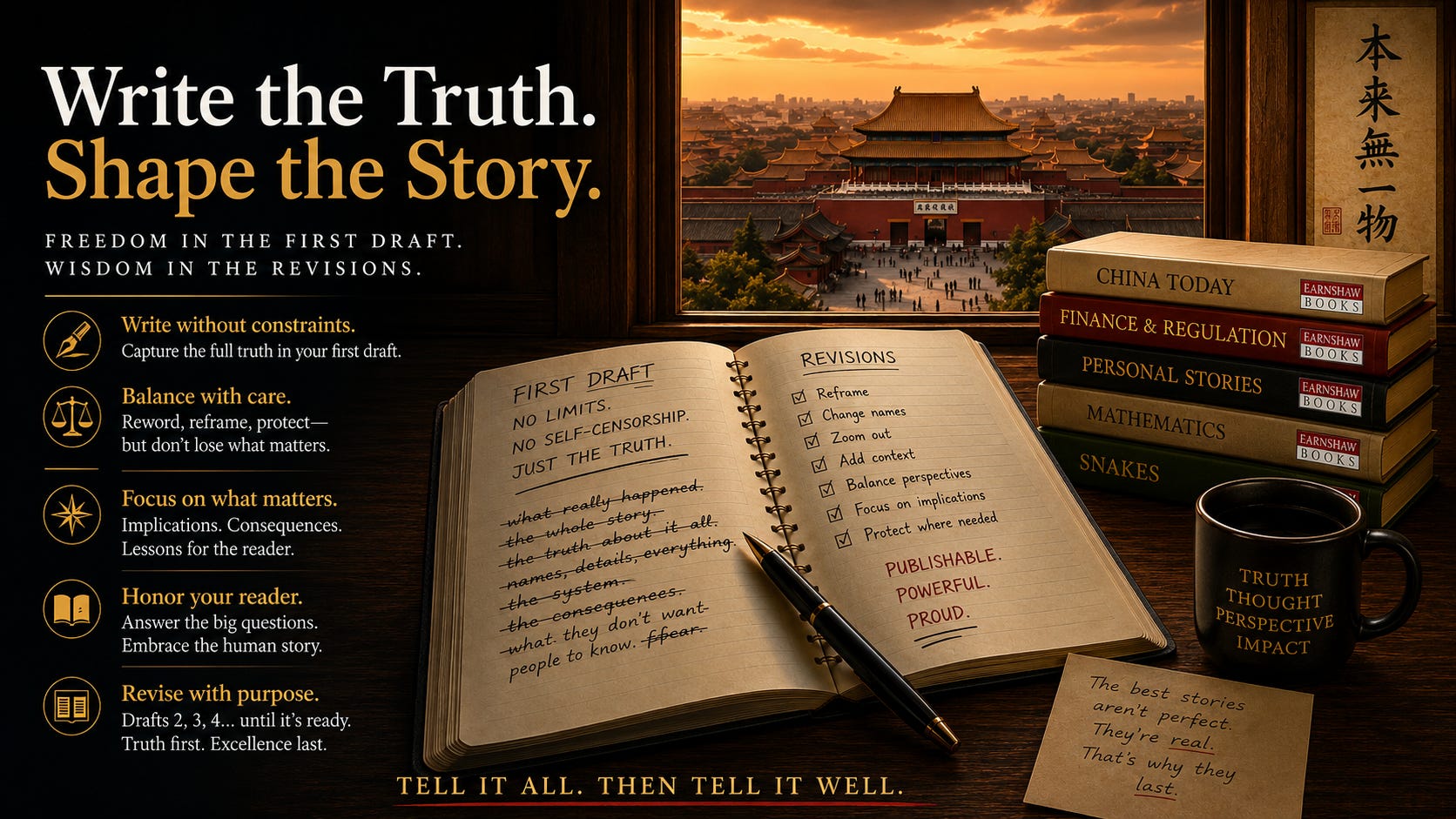
As an active publishing house, we encourage authors and prospective authors to contact us to discuss their projects. Who knows which one is the next sensation? We’re happy, within reason, to talk to anybody about any book project. And sometimes people have personal stories or things they wish to talk about that are in some way sensitive — it might be a memoir with something embarrassing or difficult, potentially libelous, or exposing some nefarious activity — something somebody is going to complain about, something that might have consequences if it’s published.
Then there are also books dealing with China today. So many of our books relate to China in one way or another, although there’s no way we would simply limit ourselves to that area — we can, we will, and we do publish books on all sorts of topics, including mathematics and snakes. But overall, China has dominated, and China is a place with all sorts of sensitivities. A wide range of topics, if they are to be handled properly, need to address those sensitivities in some way. And the correct view, we believe, is that just about any topic can be discussed, it’s just a matter of how you phrase it, the amount of detail you go into, the extent to which you’re direct and confrontational in dealing with whatever the nasty sensitivities are. Find the right way of phrasing it, the right way of packaging and balancing it, and you’re good.
Thanks for reading! Subscribe for free to receive new posts and support our work.
So when authors come to us with suggestions or proposals for books, and they say they want to avoid this topic or that topic, the advice we give across the board is to write the first draft without any constraints whatsoever. Do not self-censor. Write it with all the detail included. Once the first draft is done, then you go back and think about how to offset various issues — perhaps reword, perhaps change names to protect the guilty, perhaps make some compromises. But you’re basing the whole story, the whole framework, on the truth, and that makes a huge difference to the final product. If you begin the process from a position of self-censorship, you’re much more likely to end up with something less than satisfactory — something approaching garbage. If something starts as truth and is then pulled back in various ways to deal with potential issues, including legal ones, you’re much more likely to end up with something that has value.
An author contacted us some years ago about the shadow banking system. There was full support, and we provided lots of comments on several drafts of the manuscript, which was based on his own experience working in a shadow banking operation in Shenzhen. It involved all sorts of dodgy, arguably illegal activities, and it was definitely worth publishing. He was concerned about using the experience he’d had in the company, what he’d seen, to explain how things are done, and we said, then focus instead on the wider perspective, because most people aren’t interested in the detail at that level anyway. What they’re interested in is the implications: what it means, how it impacts the overall system, and how it impacts on the future — allowing readers to better understand how the world works. It just needs to be grounded in a sense of reality and that begins with a honest first draft. In the end, he didn’t finish it.
This topic came up again just a few days ago, when somebody with lots of experience in the China financial industry came to us with a book proposal looking at the structure and methodology of financial regulation with regard to companies. Our view was this: if you’re going to do it, you need to refer to some of the difficult stories, particularly the ones that are already highly public, where there’s already a lot of information in the market, and talk about those from the perspective of — again — what are the consequences, what are the implications, what are the lessons to be learned. If the decision from the beginning is to write a sanitized version that consciously avoids even a hint of what the author believes to be the truth …. then better to not do it at all. In this case, the person has personal, direct experience with various dodgy cases, and he was concerned about how that could play out. The advice was the same: write it absolutely truthfully and completely, and then look at how to pull back certain elements. That way you have something you can be proud of, something with credibility, something useful to readers.
Another point to keep in mind as an author is that you have, in our opinion, a responsibility to the reader to answer, even in an indirect and vague way, the most obvious questions that are going to occur to the reader, as they read through the story or argument thread that you are presenting to them. We’ve all done stupid things in our lives, present company included, and it’s perfectly natural and understandable that people wish to sanitize stories to some extent. But on the other hand, it is the human failings, the errors, and the misfortunes which are the most grabbing for readers. They want to read about success and achievements, to bask in a sense of victory, but every story with depth and longevity also involves failure and disappointment and mistakes. The Odyssey currently springs to mind. Its hero is flawed and makes so many mistakes and that’s why the story has survived.
So the point here is simply this: as an author, never limit yourself in the first draft. Just write it as fully as possible, free of any limitations whatsoever, because there’s always the opportunity — in drafts two, three, four, five, six, and seven — to make whatever changes you like before you get to the perfect publishable number eight.
Love the insights and the tips, Graham! Just shared it because I believe many authors could benefit from it.