

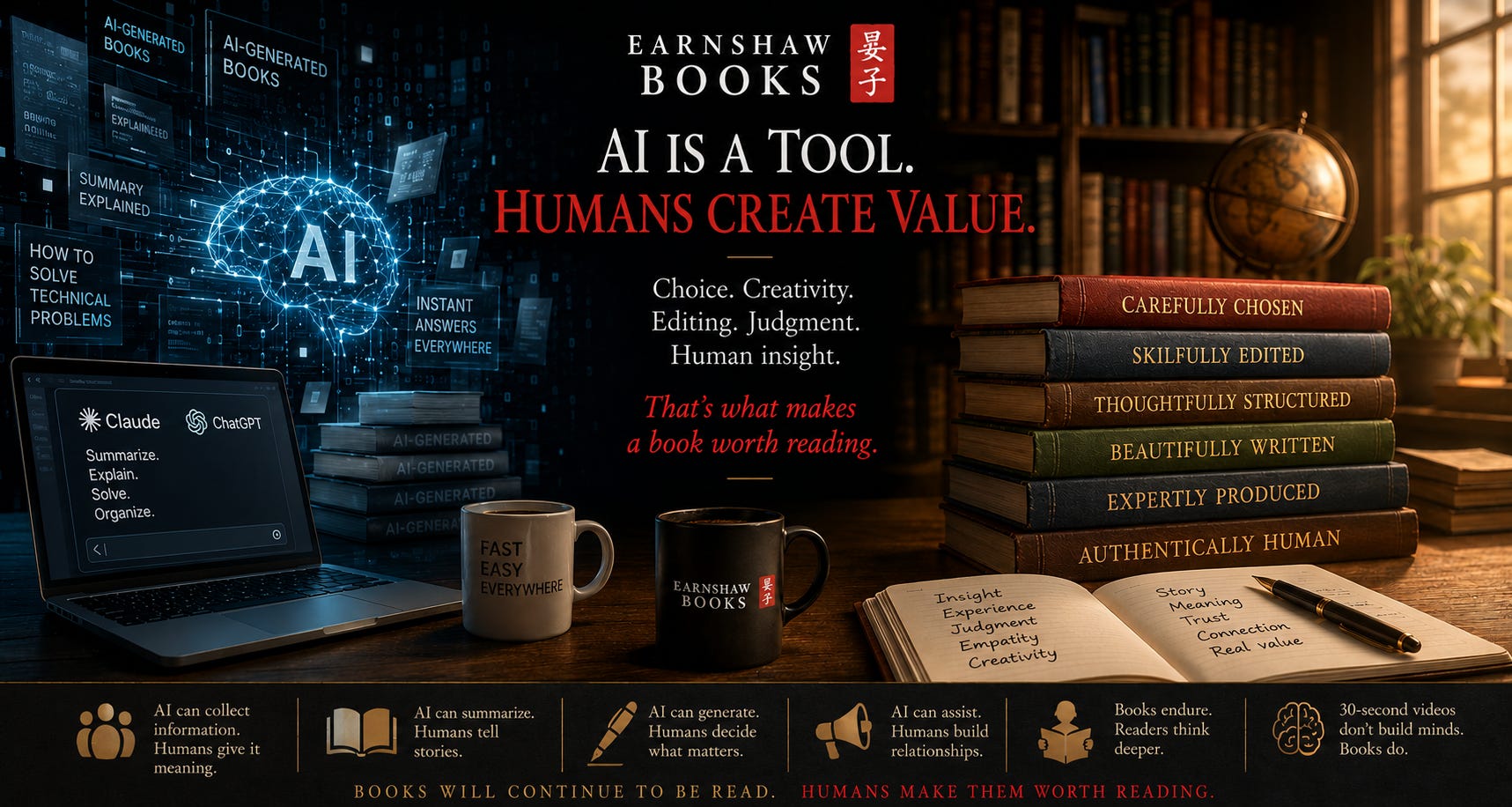
AI-produced content is exploding in all fields, definitely including the book field. Amazon is being inundated by books that were produced using AI with almost no human involvement. What value do these books have? How many copies will they sell? What is the return on investment for the people who do them? What is the longer term prospect for this means of book production and to what extent will AI produced books have a value of some sort? We don’t rule out the possibility that some kinds of AI produced books have value, particularly non-fiction books that summarize and explain something. AI is particularly useful for solving technical problems related to things like data storage, music production, and such things. Clicking on the Help or Contact Us button of the app concerned is usually useless, but Claude or ChatGPT can easily scan the web and summarize a solution to the problem. That approach could be, theoretically at least, expanded to include a range of books that are useful in terms of collating, organizing and explaining things. But the problem from the publisher perspective is that just anybody can do it, it’s a level playing field and tens of millions of people have access to Claude and ChatGPT just as we do and could produce exactly the same book with a prompt that is very similar. So in the end, this kind of AI book production will exist but will be quite narrow in its scope and low in value because anybody can grab that kind of information from AI.
But AI is here to stay, that is quite clear, and the data center debate going on in the United States particularly is somewhat puzzling. It is a NIMBY reaction — “not in my back yard” — which is fine, but on the other hand we all use AI and the data processing has to be done somewhere.
China has been very smart in terms of expanding electricity production capabilities and placing data centers in places with lots of sunshine well away from major population centers. Inner Mongolia, Xinjiang.… There’s a need for high efficiency power transmission networks, but China appears to have achieved this. But our guess is that before too long a high proportion of all AI data transmission going from my computer and your computer through to data centers and back again is going to be taken over by locally installed LLM files. The Chinese are ahead on this aspect — most of the downloadable LLMs at this point are Chinese. But in the end, others are going to produce similar files and at least some of the work that is done by AI should be done locally with no need for so much data transmission from one place to another.
Anyway, we need AI. Putting aside the issue of the use of AI for creating content, AI is a useful tool in all sorts of ways for publishing, and the emphasis here is on the word “tool”. It is a tool and if it is clearly viewed and used as a tool, then it enhances efficiency. It can clean up and accelerate processes in a positive way. Claude played a big role in the creation of the new-look earnshawbooks.com website, for instance.
But while there are elements of the process where AI can help, the fundamentals, that is the choice and production of the books, the editing and proofing, decisions on structure, grammar and word usage, and the fundamental marketing decisions, all have to involve human beings to create valuable products. AI will be involved, but there is an inherent and indispensable human element to the choice, completion, production and marketing of good books which cannot be fundamentally replaced by AI. Accounting jobs and coders? Big danger.
That may sound like a rather courageous prediction, but it also could be true. People have an increasingly sensitive nose for spotting AI slop, anything produced by AI, and we are all consciously or unconsciously looking for something real. Ergo, humans are needed.
This is a discussion that is going to go on for a very long time and we are just at the beginning of it. Meanwhile, overall book readership continues to fall off. But we believe that books will continue to be read and that those who read books have an inbuilt advantage over those whose brains can encompass little more than a 30-second video. I asked Claude and he agrees, so that settles it.
A very cogent and perceptive assessment of what’s going on, IMHO.